
What to do if you Find a Baby Bird
The following is a quick guide to help you make the right decision
should you find a baby bird that you think might be in need of rescuing.
Many
species of birds such as robins, scrub jays, crows and owls leave the
nest and spend as many as 2-5 days on the ground before they can fly.
This
is an absolutely normal and vital part of their development. They are
cared for and protected by their parents and are taught vital life
skills (finding food, identifying predators, flying) during this period.
Taking these birds into captivity denies them the opportunity to learn skills that they will need to survive in the wild. Unless a bird is injured, it is essential to leave them outside to learn from their parents.
Nestlings on the Ground
If you are concerned that the bird fell from the nest too early, you may try and return the bird to its nest.
If the nest has been destroyed or is unreachable, you may substitute a strawberry basket or small box lined with tissue and suspend it from a branch near to where you believe the nest is located.
Birds have a poor sense of smell and very strong parental instincts and will usually continue caring for their young.
However, adult birds are cautious after any type of disturbance and it may take several hours before they approach the nestling.
During this period it is essential that humans not approach the nestling.
Fledglings on the Ground
Fledglings are typically fully feathered, with a short tail and wings. They are able to walk, hop and flap and may attempt short flights, but are still being cared for by the parents.
If you find a fledgling, it should be left alone or at the most, placed into a nearby shrub. Keep people and pets away so the parents will continue to care for it until it can fly.
Placing fledglings back into nests is typically only a short-term solution, as they will quickly re-emerge. Moving fledglings to entirely new locations is also ineffective as they are still dependant on their parents for survival and will quickly starve.
Common Questions and Concerns
Why can't I raise it myself or bring it to the Wildlife Care Center?
Raising wild birds in captivity is always a last resort and should only occur when a young bird is known to be injured or orphaned. Although it may seem "safer" to raise young birds in captivity, birds raised without the benefit of learning from their parents only have a minimal chance of survival when released. (photo: ©Marti Stromberg)
My neighborhood is full of cats, dogs, cars and other potential hazards
These are very real hazards and do lead to mortalities. However, all young birds face hazards regardless of whether they live on urban, suburban or wild landscapes.
The best thing you can do is to try to reduce hazards wherever possible. Bringing individual baby birds into captivity will not help either its siblings or the many other birds nesting in your neighborhood.
I feel like I need to do something to help this bird
As difficult as it may be, oftentimes the best thing you can do is leave a baby bird alone and try to reduce neighborhood hazards.
A baby bird may seem helpless and vulnerable, but many do survive even in the most urban of locations. While it may feel safer, removing young birds from the wild usually reduces their chance for survival.
So you want me to wait until the bird is injured to bring it to you?
Our hope is that you will be able to help reduce some of the hazards facing baby birds in your neighborhood. This is the best way to not only protect the bird you have found, but also all the wildlife in your neighborhood.
The Wildlife Care Center is a hospital, and bringing healthy baby birds to a rehabilitation facility to prevent them from being injured makes no more sense than raising healthy human children at a hospital to prevent them from becoming sick.
Special Cases
Vaux's swifts
Many people are surprised to hear very noisy birds chattering in their chimney in the late spring. These are almost always Vaux's swifts.
Swifts attach stick nests to chimney walls using saliva. Their young have Velcro-like feet that allow them to actually climb up and down the walls of the chimney. Occasionally a youngster will be found at the bottom of the chimney.
The best thing to do is to reach up and affix the bird to the wall of the chimney above the fireplace (it will grab hold) and close the flue behind it. Swifts are almost impossible to raise in captivity, so reuniting fallen swifts with their parents is essential.
Owls
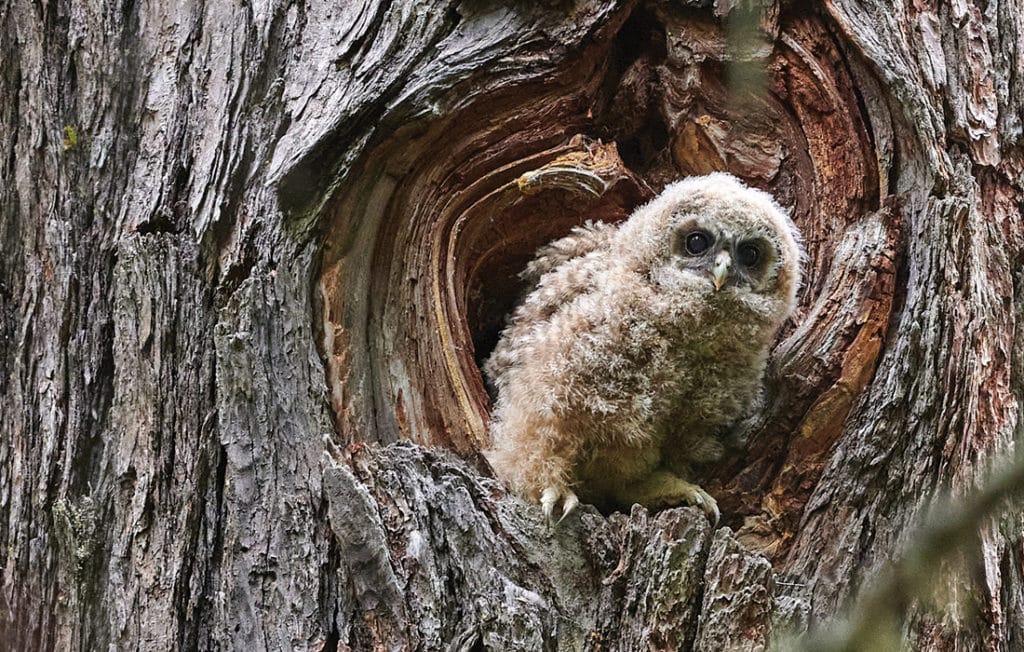
Owls are some of the earliest birds to fledge. Young owlets leave the nest and begin exploring nearby branches long before they are able to fly. Sometimes a swift gust of wind or a misstep will bring them to the ground.
If you find a young owl on the ground, try placing it on the highest nearby branch you can find. They will frequently make their way back up the tree.
Killdeer
Killdeer are notorious for nesting in highly traveled areas. Their young are precocial and are able to walk and feed themselves at hatching.
People frequently hear young killdeer doing their high-pitched peeping and feel compelled rescue them. In most cases, a parent is hiding nearby and will return as soon as the area is vacated.
Ducklings and goslings
Many of our urban parks are overcrowded with waterfowl. As a result, female mallards and geese will often nest far from water and then have to lead their young back to the park when they hatch.
Ducklings and goslings are precocial, meaning that they are able to walk and feed themselves as soon as they hatch. People are often temped to "rescue" goslings and ducklings when they see them traveling near busy roads with their mothers.
These well-intentioned interventions usually end badly with the mother spooking and orphaning her young or with the young scattering and getting run over. It is far more helpful to allow them to proceed as a group and to try and stop traffic for them wherever it is safe to do so.
Did you know?
-
At least 209 bird species have been documented in the Portland Metro Area.
-
The largest known Vaux's swift roost in the world occurs every fall at the Chapman School in northwest Portland when as many as 35,000 swifts congregate for their fall migration
-
4% of the known peregrine falcon nests in the state of Oregon occur within Portland City limits
-
Our parks and greenspaces serve as valuable rest-over spots for migrating neotropical songbirds
-
Cat predation is the number-one cause of wildlife intake and mortality at the Wildlife Care Center. As many as 40% of the animals brought to our facility are brought for reasons related to cat predation.
Common Songbird Maturation Schedule (varies by species)
| Age | Days | Description |
| Hatchling | 0-3 | wisps of natal down on body, eyes closed |
| 3 | eyes open | |
| Nestling | 4 | primary feathers (also called pin feathers) pierce skin, they look like blue tubes sticking out of the skin |
| 6 | nestling responds to alarm call of parent | |
| 7 | primary feathers unsheath | |
| 10 | bird is alert, stretches wings and legs | |
| 13-14 | able to flutter and hop from branch to branch, fully feathered, but has short tail and wings, leaves the nest | |
| Fledgling | 14-28 | they do not return to the nest, but are still fed by the adults in nearby trees or on the ground if the young have not yet mastered flying |
BEFORE TAKING ANY BABY BIRD OUT OF THE WILD, PLEASE CONTACT THE WILDLIFE CARE CENTER AT 503.292.0304.