Barred Owl EIS Comments
January 11, 2010
Mr. Paul Henson
Field Supervisor
U.S. Fish & Wildlife Service, Oregon Fish & Wildlife Office
2600 SE. 98th Ave. Ste. 100
Portland, OR 97266
Sent by email: BarredOwlEIS@fws.gov; paul_henson@fws.gov
Dear Mr. Henson,
I am writing on behalf of the Audubon Society of Portland to provide scoping comments for the proposed Environmental Impact Statement (EIS) related to the experimental lethal control of barred owls (Strix varia) to assess the potential conservation benefits to the recovery of the northern spotted owl (Strix occidentalis) in the Pacific Northwest. Audubon Society of Portland was represented by Bob Sallinger in meetings during the past year facilitated by the US Fish and Wildlife Service (FWS) exploring the ethical implications of lethal control of barred owls and also participated via Bob Pearson in the FWS Barred Owl Working Group. We appreciate the Service's efforts to date to explore both the scientific and ethical aspects of lethal control of barred owls.
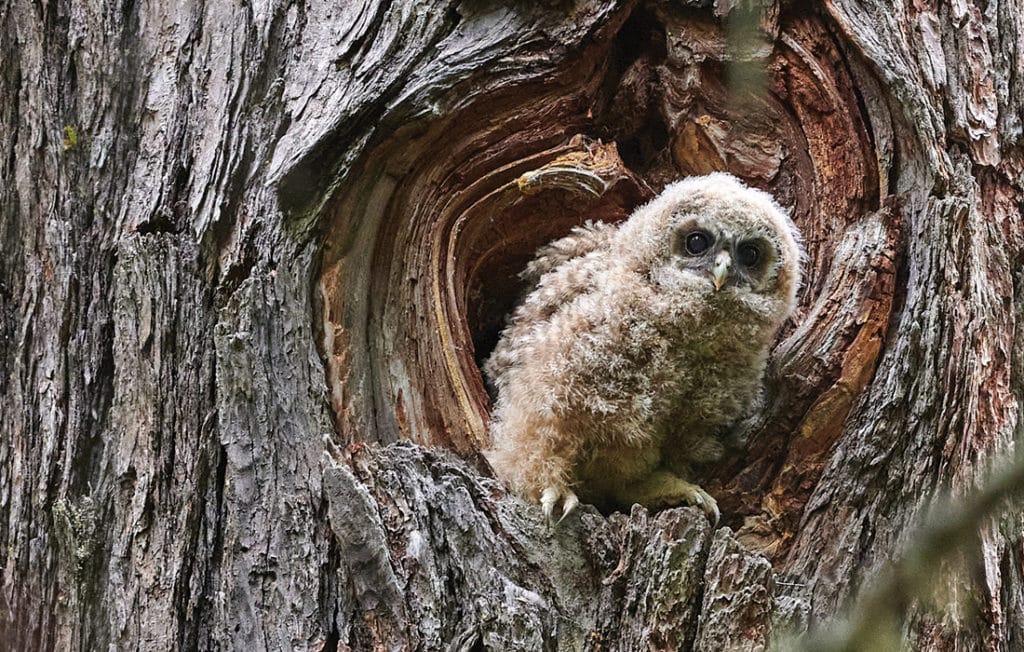
We are deeply concerned about the ongoing declines of northern spotted owl populations. Despite more than a decade and a half of protection under the Northwest Forest Plan, northern spotted owls continue to move ever closer to extinction. Populations have been virtually eliminated in British Columbia, are declining at a rate of 7%/ year in Washington and are declining at an annual rate of 4% over their entire range. While the original basis for listing the northern spotted owl as threatened under the Federal Endangered Species Act in 1991 was fragmentation and loss of critical habitat, we agree with the Fish and Wildlife Service that there is substantial reason to believe that direct competition from an influx barred owls into the Pacific Northwest may be having a substantial and potentially insurmountable impact on the ability of the spotted owl to recover.
We find ourselves in a proverbial "no win" situation pitting lethal control of large numbers of barred owls on one hand against the potential extinction of the northern spotted owl and the unique evolutionary lineage that they represent on the other. This situation is a sad reflection of decades of poor stewardship of our old growth ecosystems, which has left spotted owl populations extraordinarily vulnerable to threats from a variety of sources including disease, invasive species, and stochastic events. Loss and fragmentation of old growth habitat has created the circumstances under which the arrival of a new competitor such as the barred owl could have profound impacts on the survival of the northern spotted owl. The barred owl should serve not as a scapegoat for this situation but rather as a profound reminder of social, economic, ethical and ecological costs of allowing our ecosystems to become so degraded.
Portland Audubon's position is that the highest priority must be placed on preventing the extinction of species even to the degree that this entails lethal control of other protected species. To that degree we support moving forward with the EIS, but will not take a final position on lethal control until we are able to fully evaluate the different options presented. We must see that the fundamental cause of spotted owl populations declines, loss of critical habitat, is being adequately addressed, that lethal control of barred owls, in addition to habitat protection and restoration, is a necessary condition for spotted owls to recover, and that such an approach is practicable and will substantially improve the spotted owl's chances for survival. This proposal will be controversial---the feedback that we have received from our membership on this issue is overwhelmingly opposed to lethal control of barred owls, although this opposition tends to be somewhat moderated to the degree that individuals become aware of the implications of a no action approach. We would also note that there are other Audubon Chapters in Oregon that oppose lethal control of barred owls. We believe however, that US Fish and Wildlife would be irresponsible not to take a hard look at the mounting evidence that control of barred owls may be a necessary, albeit far from sufficient, condition to recover spotted owls. To continue forward as though barred owls do not exist would be irresponsible and contrary to the mandates of the Endangered Species Act. Again we reiterate that Audubon Society of Portland will reserve taking a final position on whether lethal control should actually be implemented until we are able to analyze the alternatives presented in the EIS. Our support at this time is specifically limited to moving forward with the EIS.
We would urge the Fish and Wildlife Service to consider the following issues in developing the EIS:
- The Fish and Wildlife Service should place the highest priority on ensuring that the habitat needs of the spotted owl are adequately met. Controlling barred owls without adequately addressing the habitat needs of the spotted owl would simply be an obscene diversion. Experimental lethal control options should not be considered in isolation but rather in relation to their efficacy in relationship to habitat protection scenarios. The decisions by the US Fish and Wildlife Service to withdraw the BLM Western Oregon Plan Revisions, vacate the 2008 Critical Habitat Revisions and remand the 2008 Northern Spotted Owl Recovery Plan were significant steps in the right direction. We support continuing to utilize the 1994 Northwest Forest Plan as the basis for restoring northwest forest ecosystems and recovering the spotted owl. However, we also believe that the Fish and Wildlife Service should be looking for opportunities to expand upon the Northwest Forest Plan by protecting all spotted owl nesting, roosting and foraging habitat in mature and old growth forests. The continued decline of spotted owl populations and the increasing threat posed by the expanding range of the barred owl call for increasing habitat protections in order to both compensate for habitat lost to barred owl occupation and to increase the potential for the two species to come into some degree of equilibrium over time. We urge the Fish and Wildlife Service to expedite revision of the Recovery Plan to the degree possible to demonstrate to stakeholders and the general public the federal government's commitment to habitat protection for the spotted owl. We also urge the Fish and Wildlife Service to focus additional attention on the role of state forests and private forest lands in recovering spotted owls..
- In general, Audubon Society of Portland supports continued, full protection for the barred owl under the Migratory Bird Treaty Act of 1918 throughout its range. There are many native avian species in Oregon and across the nation which have experienced range changes over the past century and which continue to enjoy the full protection of the law. These situations are certain to become more common as the effects of climate change become more fully realized. Barred owls are a beautiful, charismatic, and highly visible species that in the vast majority of occurrences across the Western United States can serve to connect people to the landscape and serve as ambassadors for conservation. Audubon Society of Portland recognizes that barred owls will be a permanent resident of the Pacific Northwest landscape and generally encourages the public to enjoy these birds and protect the habitat on which they and other species depend. The range of the barred owl was historically limited to the Eastern United States and Eastern Canada. Beginning in the early 1900’s, the species began a rapid range expansion into the Western United States and Western Canada. Barred owls were first reported in British Columbia in 1943 and in Oregon in 1974. The species has been able to establish itself in conifer and mixed conifer-deciduous forests throughout the Pacific Northwest. It has demonstrated an ability to utilize a variety of forest age classes and to successfully nest in environments ranging from urban parklands to old growth forests. The range expansion of barred owls is not fully understood and may have involved both natural and anthropogenic elements.
- The EIS should provide as much detail as possible about what level of effectiveness would constitute a basis for moving from experimental control to landscape level implementation. Simply improving the spotted owl's chance of survival should not be sufficient to move beyond experimental control---FWS should be able to demonstrate that lethal control of barred owls is a necessary condition for spotted owl recovery and that it would result in a substantial statistical increase in the likelihood of spotted owl recovery above and beyond that chances provided by habitat protection alone. The experiments should be designed to ensure that this type of analysis will be feasible.
- Experimental proposals should evaluate the efficacy of this approach at removal levels below 100%. It is unlikely that FWS will be able to entirely control barred owl populations at larger geographic scales. Any experimental control should evaluate whether this is still a viable approach if less than 100% of the local barred owl population is successfully removed.
- The EIS should evaluate not only the ethical parameters of lethal control of barred owls but also the potential impacts on public support for spotted owl recovery efforts specifically and avian conservation in general. The EIS should specifically describe education and outreach strategies to address public opposition and to increase understanding of the challenges of spotted owl recovery. We are concerned that lethal control of barred owls may actually undermine long term support for spotted owls and also may exacerbate situations involving illegal poaching of other avian species. While lethal control of protected species is not new in the context of ESA recovery, depredation, or scientific research, we cannot think of any situations where the target was this charismatic, where the geographic and temporal scope of the activity was this expansive, or where coverage and opposition was likely to be this extensive.
- The EIS should explicitly acknowledge that any experimental control is being conducted with the purpose of determining whether lethal control on a much a larger scale is warranted. Public statements by the Fish and Wildlife Service to date downplay the ultimate purpose of this proposal. However this proposal is not being considered simply to expand our understanding of spotted owl-barred owl interactions--it is being conducted for the specific purpose of determining whether long-term lethal control of barred owls at a much larger geographic scale is warranted. This fact should be explicitly and transparently conveyed in the EIS.
- One of the options considered in the EIS should include non-lethal strategies for controlling barred owls. There will likely be strong public pressure to adopt non-lethal strategies. The viability of non-lethal approaches should be fully explored in order to provide the public with a clear understanding of the cost, efficacy and practicality of non-lethal approaches.
- The EIS should clearly describe any methods that will be utilized to control barred owls. Specifically the EIS should describe how humane treatment will be ensured and how non-target impacts will be avoided. Any methods utilized should have the potential to be implemented at a much larger geographic scale. It does not make sense to utilize control strategies in the experimental phase if those same techniques will not be practicable from an economic, logistical, technical or ethical perspective at a landscape scale. Whatever techniques and standards are used in the experimental phase should be replicable in subsequent phases.
- The EIS should provide an economic analysis of the costs of implementing the experimental approach at a large landscape scale. It does not make sense to conduct lethal control experiments if it would be fiscally impossible to replicate those efforts at the geographic and temporal scale necessary to significantly improve the spotted owl's statistical chance of survival.
- The EIS should evaluate the best available science on the time period necessary to conduct barred owl control in order to be effective. One of the most common questions that we receive at Audubon regards how long lethal control activities may be necessary. Opposition increases dramatically to the degree that the public perceives lethal control as a potentially permanent component of spotted owl management. The EIS should clearly and explicitly address the likelihood that spotted owl and barred owl populations will eventually reach an equilibrium that will eliminate the necessity for ongoing lethal control.
- We are disappointed by the Fish and Wildlife Service's decision to utilize a 30-day notice and comment period over the holiday season for this scoping process. We understand that the Fish and Wildlife Service hopes to have a decision in time for the 2011 nesting season. However this urgency should not preclude reasonable comment periods. While the Fish and Wildlife Service has done a laudable job exploring this issue with key stakeholders over the past twelve months, a formal 30-day scoping process during the holiday season undermines our ability to go through standard internal comment approval procedures, to reach out to other chapters, and to solicit broader input from the general public. We respectfully encourage the Fish and Wildlife Service to proceed with the more deliberative approach that has marked the majority past twelve months.
Audubon Society of Portland recognizes that at this point protection of mature and old growth forest ecosystems alone, while necessary, may not be sufficient to recover the northern spotted owl The limited research conducted to date indicates that nesting suppression caused by direct competition from barred owls is in fact negatively impacting severely imperiled spotted owl populations. Given the period of time it will take for old growth ecosystems to regenerate and spotted owl populations to recover, we recognize that strategic control of barred owls may be necessary to prevent the spotted owl from going extinct and we support the Fish and Wildlife Service's decision to take this issue head-on. We hope that these comments will help the Fish and Wildlife Service to develop an EIS that will determine whether lethal control of barred owls is in fact not only a necessary component of spotted owl recovery, but also a practicable, sustainable and ethically viable strategy for spotted owl recovery.
Thank you for your consideration of our comments.
Bob Sallinger
Conservation Director
Audubon Society of Portland