2011 Archive
Care center happenings in 2011.
December 28: Western GullAt the Wildlife Care Center, winter brings all kinds of gulls. On Dec 23, we received a hatch-year Western Gull from North-west Portland, courtesy of Multnomah County Animal Services. The gull fractured its right radius-ulna and bruised its left digits. Its right wing will be splinted for approximately 1.5 weeks and it has a guarded prognosis until the bones heal. The Western Gull is a large gull that lives on the west coast of North America from Canada to Mexico. Like most gulls, it has 7 different color patterns-- one as a juvenile, a winter and summer pattern its first year, a winter and summer pattern its second year, and a winter and summer pattern as an adult. The Western Gull hybridizes extensively with Glaucous-winged Gull, especially in Washington. The Western Gull is an opportunistic omnivore, capturing its own prey (including fish, marine invertebrates, and the eggs of other birds), scavenging refuse, and even usurping food. |
December 14, 2011: Merlin
Merlins are small, migratory falcons that live in the Northern Hemisphere. In North America, Merlins breed in Alaska and Canada and winter in parts of the United States (including Oregon) and from Mexico to northern South America. The Wildlife Care Center is currently caring for a male Merlin that was likely hit by a car. (Being hit by a car is a common reason that birds are brought to the WCC.) He suffered head trauma and a broken bone (his left coracoid). While he heals, his prognosis is stable but guarded. Because they rely on their speed and agility to hunt their prey, Merlins tend to live in open areas, including open woodlands, marshes, prairies, estuaries, shrublands, grasslands, steppes, and moorlands. They form monogamous pairs during breeding season, and nest in abandoned corvid or hawk nests. Merlins primarily eat small birds, as well as larger birds, insects (such as dragon flies and moths), small mammals (such as bats and voles), and reptiles. Merlins are known for their aggressiveness and agility, which helps them catch prey as well as avoid becoming preyed upon. |
Oct 27 Band-tailed pigeon update:The last two Band-tailed pigeons (both of which were window strikes and had broken bones) have been released. This year, the WCC has released 13 Band-tailed pigeons! |
December 8, 2011: Dark-eyed Junco
Dark-eyed Juncos are year-round residents of the Pacific Northwest and the Wildlife Care Center is currently caring for four of them. Junco 2441 is a cat caught bird from Beaverton. It arrived with paresis of the legs (it was unable to stand) and had difficulty breathing. It was treated with antibiotics and a medication to reduce swelling of the spinal cord. While most victims of cat attacks aren’t so lucky, it is currently in a flight cage, preparing for release! Dark-eyed Juncos are a medium sized sparrow that have gray or brown feathering, a pink bill, a lighter abdomen, and white outer tail feathers. They breed (nesting on the ground) in coniferous and deciduous forests across Canada, the western United States, and in the Appalachians. During winter, they form flocks, and can be found in woodlands and fields across the United States and in Mexico. They primarily eat seed, but during breeding season, they will also eat insects. Outdoor cats (including those that have homes and are allowed outside) kill millions of wild animals (including birds and squirrels) every year. Unfortunately, bells have been proven to be ineffective at preventing these casualties. Additionally, outdoor cats are at increased risk for disease, being hit by a car, and being killed by a predator. It is estimated that cats that are allowed outside have an average of less than 5 years, compared to an indoor only cat which lives for an average of 12 years. For the health and safety of both the birds and your cats, keep your cats indoors. For more information on outdoor cats and how to make your cat into an indoor cat, please visit http://audubonportland.org/backyardwildlife/brochures/cats/cats. |
December 2: Varied Thrush![]() Every year, between October and April, the Wildlife Care Center receives 20 to 50 Varied Thrushes, primarily due to window strikes and cat contact. This year, the WCC has already received 15 Varied Thrushes, 2 due to cat contact and 7 due to window strikes (with 2 more that were possibly due to window strikes). To learn how you can help reduce window strikes, you can visit our Bird Safe Portland page. Varied Thrush 2357 was presented from SW Beaverton due to a window strike. On presentation, he was severely neurologic and was given supportive care, including a medication to reduce brain and spinal swelling. It took approximately a week for the neurological symptoms to subside, and he is currently in a pre-release flight cage preparing for release. Varied Thrushes are a member of the thrush family (Turdidae) and are closely related to American Robins. They have burnt orange on their chest and throat, with a dark mask, back, and chest band. They breed in Pacific Northwest in mature coniferous or mixed forests. Many migrate south (to California) and/or to a lower altitude (such as Portland) for the winter. They are omnivores, feeding on arthropods, fruit, and acorns. |
Oct 27 Band-tailed pigeon update:Of the five pigeons that were being rehabilitated by the Wildlife Care Center, four have been released and the remaining one is in a pre-release flight cage, preparing for release. Another Band-tailed pigeon, which also hit a window and suffered a broken bone, has joined that pigeon. We are hopefully that these two native pigeons will also soon be released. |
Sept 21 domestic duck update:Along with three domestic ducks from the Westmoreland Park roundup, this domestic duck found a wonderful, new home! We are pleased that this little duck, which had such a rough start to life, will have such a superb second chance! |
November 21: Western Screech Owl
On Halloween, a Western Screech Owl was presented to the Wildlife Care Center from Sherwood. This little owl made news, as several neighbors helped it on its journey to the Wildlife Care Center. The owl was likely hit by a car, and it was initially kept in an incubator, with access to heat and oxygen. Despite this rough start, it is currently in a pre-release flight cage. You can keep tabs on it by logging onto our facebook page! |
November 10: Common Raven
Nov 21 update: We released the Common raven at its site of origin in Zig Zag (a volunteer drove all the way out to Zig Zag). At the time of release, he was strong and healthy; his weight was stable and nearly twice that of when he arrived! In mid-September, an emaciated, weak Common Raven was presented from Zig Zag to the Wildlife Care Center. Immediate action was taken to stabilize the animal, including giving fluids and providing warmth. Although it did have a heavy load of parasites, the raven did not appear to have any injuries. Parasites, although not uncommon, can cause wild and domestic animals to deteriorate, especially if something else is wrong with the animal (such as an illness or an injury). While treating the raven for both the parasites and emaciation, the raven gained weight and strength. He is currently preparing for release in a flight cage. Ravens are highly intelligent birds in the Corvidae
family, and are related to crows, jays, and magpies. Compared to
American Crows, ravens are approximately 3 times bigger and have a
significantly bigger/thicker beak. They tend to live as pairs in wooded
areas, near open areas and/or waterbodies. They are opportunistic
omnivores, and their diet varies based on location and season, but may
include carrion, fruit, and eggs. |
November 3: Western Painted Turtle
The
Wildlife Care Center is currently rehabilitating four Western Painted
Turtles and has a Western Painted Turtle as an education animal. Of
these five animals, three were hit by vehicles and two were confiscated
from people who had them illegally (one later developed pneumonia, which
it’s being treated for). Turtle number 1552 is an adult male turtle
that was hit by a van in July of 2011. We are currently developing a
protocol to help correct the damage done to his shell due to this
incident. However, even with luck, this turtle, and the other 2 that
were hit by vehicles, will be in care for at least 1.5 to 2 years, as
turtles heal very slowly. |
October 27: Band-tailed Pigeon
The Wildlife Care Center is currently rehabilitating five Band-tailed Pigeons. Three of them were presented due to cat contact (including one that had to be hand-raised), one was presented due hitting a window, and one was presented as a youngster after a failed re-nesting attempt (it was very malnourished). The one that hit the window had a leg that was broken in multiple places and was thin. The donors had kept the bird for multiple days, and had attempted to set the leg and feed it, but when the bird arrived here, the leg needed to be splinted, the bird was so malnourished and injured that it wouldn’t eat on its own so we had to hand feed it, and it needed medications to reduce swelling and pain, as well as calcium to help heal the bone. After being here for nearly one and a half weeks, the bird is eating on its own but the prognosis is still guarded as the leg is still healing. It’s always in a sick or injured animal’s best interest to bring it to the Wildlife Care Center as soon as you find it so that we can begin appropriate treatment and provide appropriate food. Band-tailed pigeons are one of two native Columbiformes (pigeons or doves) in the area and one of four Columbiformes found in the area. The other native Columbiforme in the area is the Mourning Dove, while the two feral Columbiformes are the Rock Pigeons (also called city pigeons or rock doves) and the Eurasian Collared Doves. (The WCC rehabilitates Band-tailed pigeons and Mourning doves, but does not rehabilitate Rock pigeons or Eurasian Collared Doves.) Band-tailed Pigeons are similar in size to rock pigeons but have yellow beaks and legs, and a gray band on their tails. Unlike rock pigeons, which prefer to live in cities, Band-tailed pigeons prefer oak, coniferous, and mixed forests at altitudes of 900 to 3,600 m. They eat seeds (notably acorns), as well as fruit, pine nuts, and flowers. |
October 12: Surf Scoter
Although they are a sea duck, the Surf Scoter (also called “skunk-headed coots”) breed in Canada and Alaska and winter on the coast of the northern USA, with some birds migrating to Europe and the Great Lakes. They dive for crustaceans and mollusks, and ducklings live off of freshwater invertebrates. (This juvenile is being fed mealworms and bloodworms, in freshwater, which are being supplemented with nutrients according to its needs.) Although they are considered a species of least concern, the San Francisco harbor oil spill in November 2007 killed thousands of Surf Scoters and their population has declined at least 50 percent over the past 40 years. |
October 6: Saw Whet Owl
![]() October 6 Update: Northern Saw-Whet Owl: This Owl, from
Clatskanie, originally arrived with an injured right wrist. Although it
was in a pre-release flight cage, it was brought back from the flight
cage with an injured right radius and ulna. The veterinarians determined
that it was blind in its right eye. After significant rehabilitation of
its wing, gaining some weight, more flight training, and ensuring that
it could hunt live prey without injuring itself, this first-year
Saw-Whet Owl was released last week at its site of origin! On September 9, the Wildlife Care Center received a juvenile Northern Saw-Whet Owl from Clatskanie with an injured wrist and ectoparasites. After having her wing wrapped for a week and treating the parasites, the juvenile is currently getting her strength up, preparing to be released. Saw-Whet Owls are the third smallest owl in Oregon (normally 54 to 124g), only slightly bigger than Flammulated Owls (46 to 63g) and Northern Pygmy Owls (54 to 87g). They primarily live in small, dense conifer trees, nest in tree cavities, and eat mice, small birds and insects. Each year, the WCC receives an average of 5 Saw-Whet Owls and we are happy that this one will soon be released |
Sept 27 Gunshot Red-tailed Hawk
Within the past week, the Wildlife Care Center has received multiple birds that have been illegally shot. One of them was a beautiful adult Red Tailed Hawk from Toledo, Washington. The bird was found to have a piece of shot in its leg, a broken humerus (wing) and multiple other injuries. The only way to save the wing and possibly save the bird was to surgically repair the humerus. Although the bird was in stable condition, sadly it had to be euthanized, due to severe nerve damage. Red Tailed Hawks are a raptor within the Buteo genus, which includes wide-ranging raptors with large bodies and broad wings. The Red-tailed Hawk is one of the most common and one of the largest hawks in North America. Females are larger than the males and lay 1-5 eggs a year, and together the pair raises the young. Those from Alaska and Canada migrate south, while birds from the rest of the continent typically do not, sharing the countryside with northern counterparts. They are protected under the federal Migratory Bird Act and state law. Shooting or killing a protected bird (such as a hawk, crow, or other non-game species) is a federal and state crime. In 2007, the Portland Audubon began intensive lobbying to ensure that intentional crimes against protected bird species result in significant penalties. In 2009 and 2011, the Portland Audubon helped pass legislation to establish stiff minimum penalties for people who kill birds of prey and commit other offenses (for more information, please visit http://audubonportland.org/news/wrapup). Despite these potential punishments, poaching and illegally shooting birds continues to be a significant problem. The care and treatment of gunshot animals is time consuming, expensive and often devastating. While we always hope that this does not occur, illegal gunshot injuries too often result in the death of animals, sometimes after weeks of care. If you would like to help defray the cost of these gunshot and other animals in rehabilitation, please donate to the Wildlife Care Center. |
Sept 21, 2011 Domestic Duck
Feral animals are domestic animals that live in the wild. Portland has a number of feral animals including domestic pigeons and doves (including city pigeons), domestic ducks and geese, domestic rabbits, a variety of turtles, and cats. Many of these animals started life as companion animals, but were dumped because of cost, time and/or space. It is illegal and inhumane to dump (or to set free) any domestic animal. Domestic animals do not have the ability to fend for themselves in the wild. Most die from starvation or become easy prey for predators. Those that do survive become part of the non-native population, proliferating and taking space away from the native animals, as well as spreading disease to native wildlife. If you find that you are no longer able to care for a companion animal, there are legal and humane resources to find new homes for animals, including feed stores, humane societies and rescue groups (for a partial list, please visit http://www.animalaidpdx.org/library/resources.php). Once the domestic duck recovers from his injuries, he will be placed in a permanent home. |
September 14, 2011 Northern Flicker Window Strikes
Every year, the Wildlife Care Center receives hundreds of birds that have hit a window. Many of these birds are young (who have the size of the adults, but not their knowledge) or are migrating. Some recover in a few hours or days, while others arrive dead or die a few days later. This year, the WCC received over a dozen juvenile Northern Flickers within one and a half weeks that were believed or confirmed window strikes. Northern Flickers are a medium sized woodpecker native to Northern and Central America, and are one of the few woodpeckers that truly migrate. Although they eat fruit (especially berries), seeds, nuts and invertebrates, they primarily eat insects. Ants alone can make up 45% of their diet and help keep them free from parasites. Due to their injuries, these birds had to be hand-fed every 2 to 3 hours, were given specific medications (to reduce brain and spinal swelling), and were treated for other injuries. Even with this intense care, only a few of these Northern Flickers recovered and were released. To help reduce these window strikes, you can take the following steps:
For more information, please see tips on our BirdSafe page
|
September 5, 2011 Young Squirrels
A few days ago, we received a phone call from a family that had found two young squirrels which they believed were orphaned because the squirrels were on the ground. They were worried that their dog or the neighborhood cats would kill them and/or that they would starve to death. After carefully listening to them and making sure that the two squirrels were not injured, we assured them that the mother often moves their babies and sometimes drops the young squirrels while moving them. We advised them to pick up the two squirrels together using a towel (so that they did not touch them) and put them under a tree, to take their dog into the house, and to leave the squirrels alone for 4 hours. After four hours, they went and checked and sent me an e-mail saying, “Just wanted to let you know that both squirrel babies had… hopefully (been) picked up by their mother. Thanks for your advice - it worked beautifully!” It’s always wonderful when our advice results in a success story! If you find what you believe to be an orphaned, injured or sick wild animal, please call us for advice. Thanks to the hard work and dedication of the volunteers and staff of the WCC, we are also able to report that many of the previous stories also have happy endings. The surviving swifts were released, the five Cedar Waxwings that were presented due to habitat loss have either been released or are on their way to being released, and one Black-headed Grosbeak’s that was presented due to cat contact is on its way to release (sadly the other one passed away)! Thank you again to everybody for their hard work and dedication, and please remember to trim your trees during the winter and keep your cats inside. |
August 30, 2011 - Mink
![]() Last month, the Wildlife Care Center received an American Mink that the donor had raised for a month, believing she was a ferret. When the donor found out that the mink wasn’t a ferret, she brought the mink to the Wildlife Care Center for identification and rehabilitation. American Mink are a native, semi-aquatic, carnivorous Mustelid, with an excellent sense of hearing and sight. While mink are related to ferrets, imprinted mink will often become aggressive when they become adolescents. Mink and other wild animals never make good pets and are illegal to keep as pets. Because the mink was imprinted on humans and because mink will travel long distances via water, the mink was deemed unreleasable. Luckily, a zoo was able to take her as an education animal. However, most animals that are imprinted on people and/or raised by people do not have such a positive outcome. If you find an orphaned or injured wild animal, bring it to a wild rehabilitator as soon as possible. If this is not immediately possible, put it in a container and set the container on a heating pad set to low. Do not feed the animal or give it anything to drink, as this may harm the animal. Instead, immediately contact a wildlife rehabilitator for further advice and instructions. |
August 22, 2011
Every year, the Wildlife Care Center receives animals as the result of habitat destruction. Habitat destruction includes trees (which have nests in them) being cut down; berries bushes, roses and trees (with nests) being trimmed; and nests being washed off of buildings or houses. This year alone, the WCC has received owls, finches, Cedar Waxwings, and other animals because of habitat destruction. Federal Law prevents killing or in any way interfering with “any migratory bird, any part, nest, or eggs.” Property owners, tree trimmers and power washers may be cited and fined for knowingly destroying an active nest. The best way to avoid citations and destroying a nest is to trim your trees and bushes in between November and January, after you have thoroughly searched the area for nests and animals. Fall is considered the best time to trim trees, as trimming in the spring and summer can lead to disease. Regardless of the season, search the area by looking on the ground for a collection of droppings, looking for birds harassing you and looking for nests. This may help save the animals and can prevent you from being citation. |
August 12, 2011 - Cat Caught Black-headed Grosbeak |
July 29, 2011 - Vaux's Swifts
![]() We are currently raising eleven Vaux’s Swifts in the Wildlife Care Center. Each of these swifts came from locations where the parents were known to have abandoned the nest. These eleven nestlings keep our volunteers busy with mealworm feedings every half hour! Vaux’s swifts are aerial hunters of insects. Nesting in dark cavities, these birds use small twigs and saliva to adhere a nestcup to a vertical surface. Vaux’s swifts most commonly nest in hollow trees but will also occasionally nest in chimneys. We get many calls this time of year regarding loud chirping from someone’s chimney or they may have found a small, dark bird in the fireplace unable to fly. These are Vaux’s swifts! The young experience a relatively long nesting period of roughly four weeks and may lose their footing and fall down the chimney during this period. Don’t worry, they’re usually not injured. If this happens to you and the bird appears healthy (no apparent injuries and grasping with feet), simply pick up the bird with its feet pointing outward, reach your hand as high up the chimney as you can and allow the bird to grab onto the side wall. Once it has a good grip, instinct will direct the bird to climb upward, back towards the nest. When breeding season is over, Vaux’s swifts will return to their usual habits of roosting communally in large hollow trees or chimneys - famously, at the Chapman School chimney in NW Portland! |
July 17, 2011 - Mallard Duck UpdateAfter a full recovery and plenty of exercise, the mallard duck and her duckling were returned to the water where they were found for another chance at life in the wild! |
June 29, 2011 - Mallard Duck |
June 21, 2011 - Muscovy Duck![]() A female Muscovy duck was brought into the Care Center in late May after being attacked by other waterfowl on a pond in Vancouver. She had a large wound on her head and another on her leg making it difficult to walk. She was particularly friendly to people and had evidently been raised in captivity. We don’t know why or when she was abandoned in this unsuitable habitat. After several weeks of treatment this domestic duck has recovered and is ready to be placed in permanent captivity. Throughout the spring and summer Audubon receives a steady stream of injured domestic ducks and geese and orphaned domestic ducklings and goslings — last year we saw well over 100! Rather than send these birds back to parks that are already overcrowded, we try to find them permanent homes with private landowners who have appropriate facilities to give them a healthier, happier life. Please contact Dr. Deb Sheaffer at dsheaffer@audubonportland.org if you have a private pond or an appropriate area on your property for one of more of these birds. |
June 20, 2011 - American BitternLast Thursday morning we removed the bittern’s splint to assess healing of the broken leg. Unfortunately, the foot was no longer viable, indicating that the appendage was not receiving blood from the body and had died. It is likely the leg fractured a few days before the animal was found and irreversible damage to the bone and surrounding soft tissue occurred during that time. Sadly, the bittern had to be euthanized as there was no chance of the foot recovering. It is our goal to rehabilitate injured wildlife and return them to a natural life in the wild. Bitterns are in the heron family and use their long legs to stealthily wade through marsh and wetland habitats while searching for prey items. Without a foot, the bittern would not have been able to walk or forage for food. |
June 13, 2011 - American Bittern
This American Bittern came into the Wildlife Care Center last week from Battleground Washington where it was found down on the ground, unable to walk. The Bittern has a fractured ankle very close to the foot. After x-rays were taken, confirming the fracture, a splint was placed and will remain on for another week and a half. Bitterns are marsh birds that feed on small fish, salamanders and invertebrates. Adults are poor eaters in captivity and this bird has to be force fed fish twice daily. Bitterns are in the heron family and breed in Oregon and across northern North America and winter in the southern United States and Mexico. |
May 11, 2011 Steller's Jays
These two Steller’s Jays came in separately and because they are both fledglings of very similar age, we are able to raise them together. Raising birds with other conspecifics (animals of the same species) helps them to form natural associations and diminishes the chances of young birds habituating to people. Both of these jays were brought to the WCC because they were found sick and/or injured: one with a sinus infection and the other with a fractured leg due to a cat attack. The Care Center does not accept young birds that are not injured and/or not confirmed to be orphaned. The fledging period is fraught with hazards and challenges that the bird must overcome in order to survive in the wild. It is a critical learning period where they must not only learn to fly but also learn how to find food and water and avoid predators. Most fledgling birds are still dependent on their parents for survival. It is almost always best not to interfere with healthy fledgling birds. The most helpful thing you can do for a fledgling is leave it alone and make sure pet cats and dogs are kept indoors (a good idea anytime!). If you find what you suspect to be an injured or orphaned fledgling, please call the Wildlife Care Center for advice (503.292.0304) before capturing or transporting the animal. |
April 21, 2011 - Kildeer
If you can't spot the nest, you can put the chick in a small box with drainage holes such as a cardboard berry basket and attach it securely to a branch. If it has feathers, place it in a small shrub or tree. If you find an injured bird, please call the Wildlife Care Center at 503-292-0304. |
|
April 6, 2011 – Common Raven Update
After four months of treatment including surgery, physical therapy and daily care, the common raven that came into the Care Center with a shattered femur was released where he came from in the Columbia Gorge. The leg fracture eventually healed and but many weeks of exercise and physical therapy were required to ensure the raven is still able to use both legs to perch and walk. The cause of injury remains unknown – ravens have most often been admitted to the Care Center suffering injuries from being hit by cars and trucks as well as gunshot. Thank you to the many volunteers who gave their time and energy in treating this raven and to Rock Creek Veterinary Hospital and Dr. Tom Tsui for donating orthopedic surgery and expert advice. Photo credit: Ada Norris |
March 16, 2011 – Great Horned Owl
Owls are some of the year’s earliest nesters and we have already seen one Barn Owl and three Great Horned Owl fledglings come into the Wildlife Care Center. This particular was injured during the fledging process and came in with a bruised shoulder and dried blood under the right wing. After the soft tissue damage healed, the owlet spent two days “branching” in an outdoor enclosure. Many tree and cavity nesting owls do not fledge by jumping to the ground but rather spend time hopping from branch to branch and practicing short flight between limbs.
After six days of recuperation, the owl was returned to the park where it was found in Canby. Using a tall ladder, WCC wildlife veterinarian, Dr. Deb Sheaffer, and Audubon volunteer, John Plant placed the owlet directly on a lower limb of the fir under which it was originally found. The owlet soon proceeded to hop and climb to higher branches. The following day, watching from afar, John witnessed a parent attending to the owlet perched high in a tree adjacent to where it was released. Success! |
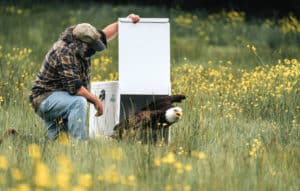
February 20, 2011 - American BeaverThe beaver was released today along the east bank of the Willamette River close to where it was found. The beaver immediately entered the water upon release and swam upstream periodically inspecting the east bank along the way. Photo by Kristina Raum.
|
February 19, 2011 - American Beaver
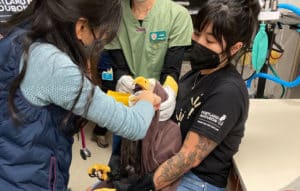
Today we sedated the beaver and transported to Cornell Center Animal Hospital where Dr. Veronica Verdoliva performed an ultrasound. Dr. Verdoliva, found no free fluids in the abdomen and all other tissues examined appeared healthy and functioning within normal limits. Cornell Center also provided a new set of radiographs taken at their hospital; the Xrays appeared normal. With regular, thorough cleaning and debriding, the original puncture wounds have healed almost completely with just very small scabs remaining on the surface of the skin. The beaver remains bright and active and there is a good prognosis for release very soon. A very special thank you to the doctors and staff of Cornell Center Animal Hospital, for donating their time and expertise in treating the beaver. (Photo caption (left to right): Dr. Veronica Verdoliva, Kathy Logan, Dr. Bethany Groves, Kristina Raum) Photo credit: Cornell Center Animal Hospital. |
February 14, 2011 – American Beaver![]() An American beaver came to the Wildlife Care Center late last month. The beaver was found injured along the east bank of the Willamette River under the Burnside Bridge and was captured and brought to Portland Audubon by an Oregon State Police officer. Although the animal had multiple, deep puncture wounds on her back, she remained bright and active. Abscesses had formed at the wound sites due to bacterial infection. The wounds were cleaned and surgically debrided by local veterinarian, Dr. Bethany Groves, and a culture was taken from the wound. Unfortunately, the bacteria growing are resistant to many antibiotic therapies. In addition to the puncture wounds, the
beaver was found to have a distended belly due to fluid accumulation in
the abdomen. This fluid could be a sign of an underlying condition or
illness that rendered the beaver more susceptible to attack by a
predator in the first place. Cornell Center Animal Hospital has
generously offered to ultrasound the beaver so that we might gain
insight as to the source of the abdominal fluid. The ultrasound is
scheduled for this coming week. About beavers: American beavers (Castor canadensis) are North America’s largest rodent and are aptly nicknamed “nature’s architect”. Beaver dams can slow the course of a river or stream and cause silt and soil to accumulate to the point that a wetland and eventually a meadow may develop. This kind of ecosystem alteration provides critical habitat for many kinds of animals including species of fish, turtles and birds. Mainly nocturnal, beavers forage for food on land at night and retreat to their watery lodges for protection from predators during the day. |
January 16, 2011 – Raven Update![]() The Common Raven that came into the care center on Dec 2 has been moved from the hospital to an outdoor enclosure where it may exercise and gain strength. The right leg fracture has healed, however mobility of the leg is limited. Nevertheless, the raven is able to fly, stand, walk, and grasp well with both feet. Time will tell if the right leg will function well enough to be suitable for life in the wild. |
January 16, 2011 – Cooper's Hawk UpdateThe swelling around the left eye has resolved completely and the bird is bright and eating well. Unfortunately, upon examination by veterinary ophthalmologist Dr. Susan Kirschner, the hawk was found to have extensive damage to the retina. We are continuing to treat the hawk with antibiotics and anti-inflammatory medications in hopes that part of the retina might reattach. |
January 6, 2011 – Cooper's Hawk Hit by Car![]() On January 2, a first-year Cooper’s Hawk was brought to the Wildlife Care Center after being struck by a car in SW Portland. The hawk suffers from head trauma and possible permanent damage to the left eye. Older abrasions found along the ankle area tell us the bird may have already been on the ground for a short while – perhaps previously hit by another vehicle. We are treating the injured eye with a mix of antibiotics and steroids and while the soft tissue surrounding the eye has already healed significantly, it remains unclear as to whether vision will recover. Cooper’s hawks are a member of the family Accipitridae family along with goshawks and sharp-shinned hawks. Accipiters have short, broad wings and long tails good for maneuvering through trees in wooded areas. Cooper’s hawks are very similar in appearance to the sharp-shinned hawk. Both are regularly seen in neighborhoods and occasionally may be spotted near bird feeders as they are agile predators of songbirds. In 2010 nearly two hundred animals known to have been hit by a car or truck were brought to the Wildlife Care Center. Many more were found near or along a roadside, suspected to have been hit by a vehicle. |


A Surf Scoter is a large, black sea duck that is
normally found on the coast. However, a few days ago, the Wildlife Care
Center received one from north-west Portland, via 

On Sunday, the Wildlife Care Center received a
young domestic duck that was found living in the wild but was unable to
walk or fly. It was unable to walk because of severe bumblefoot and
unable to fly because it is too young to fly. Bumblefoot is an
inflammatory (and often infectious) reaction on the feet of birds (and
rodents), often caused by improper surfaces (such as perches or
concrete) or by a penetrating wound. It can cause considerable damage to
the feet of the animal and may require surgery to fix. Although it
occurs more often in animals that are in captivity, it can occur in wild
and feral animals as well.


On April 20, a woman emailed this photo of some healthy baby birds that her daughter found on the road. She wondered what they were and what she should do with the adorable chicks. This is a common question in the Wildlife Care Center during the spring. They had found Killdeer chicks, which nest on the ground and are precocial, meaning they hatch feathered and ready to run after their parents to learn how to hunt for food. All chicks have a better chance of survival if they can be reunited with their parents who can teach them skills we cannot. With her children, the woman returned the two chicks to the area near the road, and the mother of the chicks returned immediately. In some cases, it may take a little while for the parents to return, but usually they are just waiting for humans to leave the area. After they leave the nest, many species of birds spend several days on the ground being fed by their parents. If you find an unfeathered, healthy baby bird, look around and see if you can return it to its nest.
April 12, 2011 - Bald Eagle
Dr. Sheaffer suspects the head and feet wounds will heal without complication, but is concerned about the shoulder trauma. At this time it’s too early to speculate on the eagle’s chance of good flight and release back to the wild.


Previous:
First ducklings of the season!